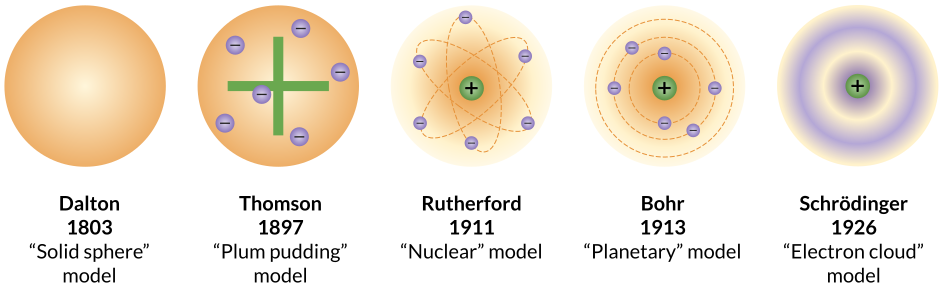
representations of atoms to help visualize atomic structure, and explain/predict the behaviour of atoms
every model sacrifices some accuracy for simplicity, visibility, or usability
Khan Academy, CC BY-NC-SA 3.0
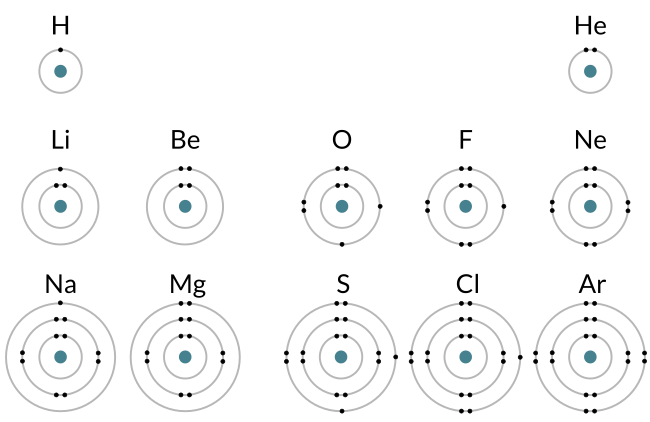
The Bohr model
Bohr model of various atoms.
Khan Academy, CC BY-NC-SA 3.0
represents electrons as particles that occupy specific, quantized energy levels
electrons are represented as black dots that sit on a ring around the nucleus
nucleus is a single circle in the center
not meant to represent what real atoms look like
Strengths
represents the particle nature of electrons, easy to see the number of electrons in an atom
electrons exist at specific energy levels, Bohr model represents these as rings
electrons on the same ring are at the same energy level
Weaknesses
does not reflect the wave properties of electrons
electrons appear to exist in specific locations, which is not entirely true
nucleus is shown as single circle, no distinct protons/neutrons
because it treats electrons as having fixed orbits, it can not accurately predict the atomic spectra for more complex atoms with more than one electron
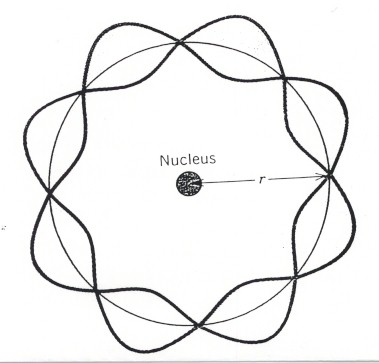
The de Broglie model
Larry Sulak, Boston U.
electrons are represented as a physical standing wave around the nucleus
higher energy levels show wave patterns with more segments, like a vibration string
does not handle the particle behaviour of electrons
The electron cloud model
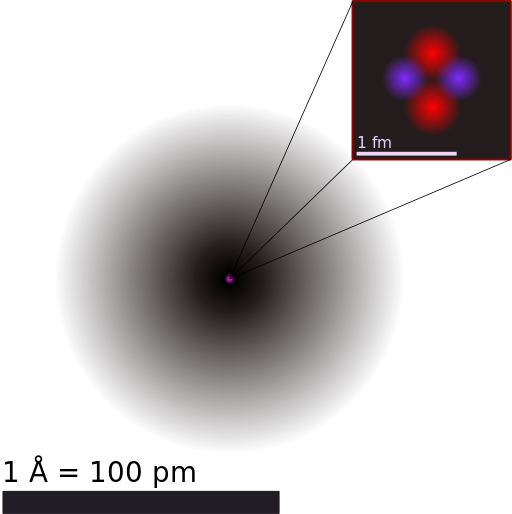
"Helium atom QM" by Yzmo, CC BY-SA 3.0
also called the quantum mechanical model, and sometimes the Schrödinger model
expanded on de Broglie’s wave model to mathematically describe electron behaviour
instead of electrons being at fixed positions, it predicts the probability distribution for where electrons are likely to be found
the nucleus is a group of individual red protons and purple neutrons
regions around the nucleus, orbitals, show the probability of finding an electron
electron transitions are represented as transitions from one harmonic to another in the wave function
represents the wave and particle behaviour of electrons
fuzzy electron cloud represents how individual electrons are distributed in the atom
until we measure the position of an electron, we don’t know exactly where it is, the best we can do is describe where they are likely to be found around the nucleus
how the nucleus is represented
individual protons and neutrons
very small compared to the size of the electron cloud
real nucleus would be invisible if properly scaled in this model
Weaknesses
does not represent the particle nature of electrons